PRINCES + PRINCESSES OF DARKNESS
May Black Vampires Reign

Vampires are among the oldest and most recognizable characters in fiction. From Dracula and Count Orlok to Edward Cullen, some of the genre’s most famous vampires have become cultural icons. Yet for much of vampire fiction’s history, these supernatural creatures have predominantly been portrayed as white. Despite this, Black vampires have been a part of the genre for more than two centuries, with many characters deserving the same recognition and attention as their white counterparts.
One of the earliest known Black vampires appeared in The Black Vampyre, an 1819 novel attributed to Robert C. Sands, who published it under the pseudonym Uriah Derick D’Arcy. The story follows a slave who is killed and resurrected as a vampire, eventually becoming known as the Prince. He seeks revenge against his former captors, with the story unfolding against the backdrop of the Haitian Revolution. The novel uses vampirism to explore themes of race, slavery, revenge, and religion, making it a notable early example of the vampire being used to examine social and political issues.
More than a century later, Black vampires began appearing on screen. In 1972, Blacula became the first major film centered on a Black vampire. The character was introduced in the blaxploitation film of the same name, played by William Marshall. Unlike the European vampires that dominated the genre, Blacula’s origins were African rather than Transylvanian. The film follows him after he is awakened in 1970s Los Angeles, where he finds himself navigating an unfamiliar modern world while struggling with his vampiric nature.
Black female vampires soon followed. In the 1989 film Vamp, Grace Jones played Katrina, a mysterious vampire stripper. Her striking performance and distinctive visual style made Katrina one of the most memorable Black female vampires in film and helped establish a place for Black women within a genre that had traditionally centered on white characters.
The 1990s saw Black vampires become even more prominent in mainstream film. Eddie Murphy played the vampire Maximillian in Vampire in Brooklyn, while Wesley Snipes portrayed Eric Brooks, better known as Blade, in the 1998 Marvel Comics adaptation Blade. Of the two, Snipes’ performance would prove to be the more influential. Blade was a critical and commercial success, and Snipes helped establish the character as one of the most recognizable Black superheroes in popular culture.
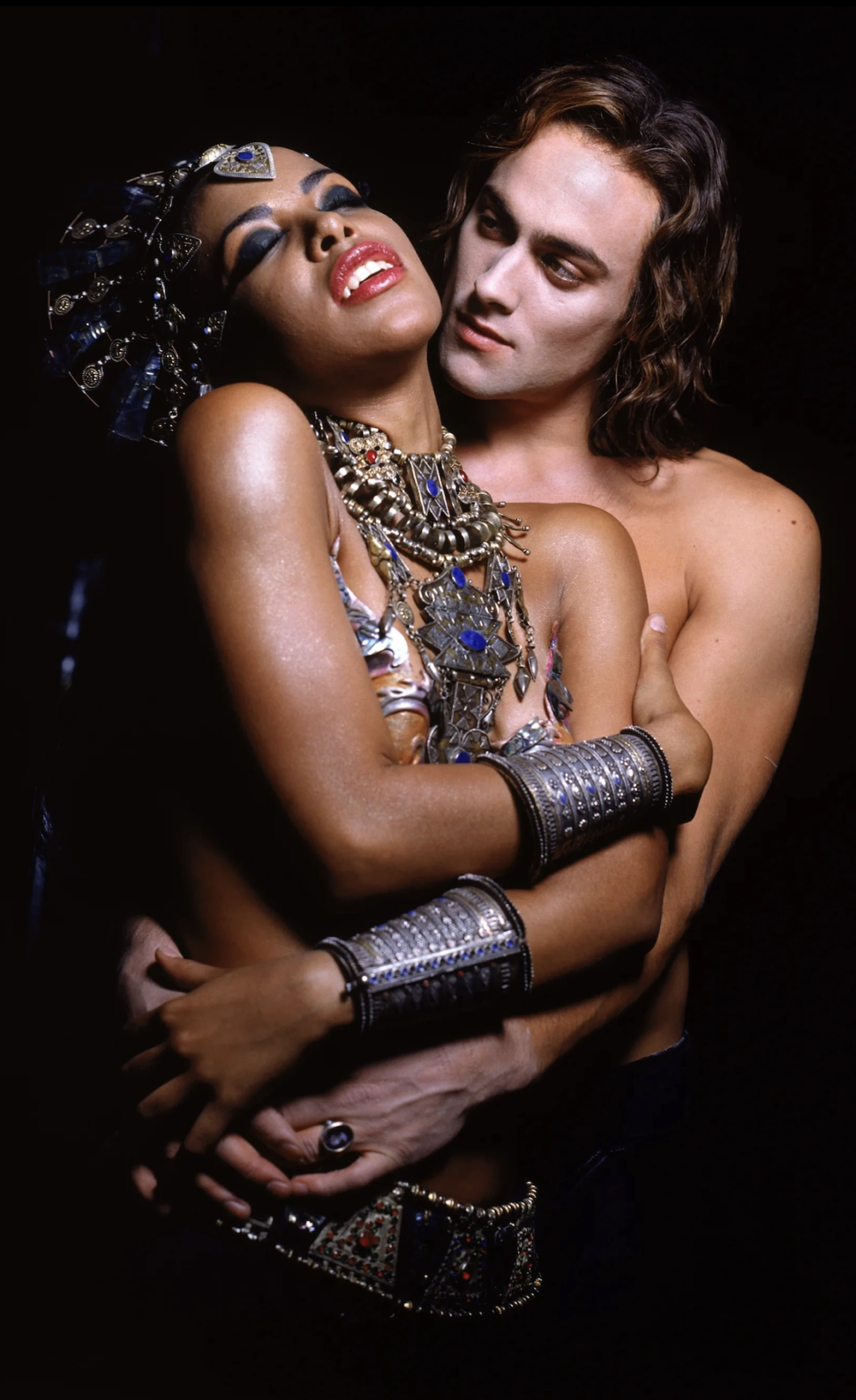
The following decade brought another notable Black vampire to the big screen with Queen of the Damned. Released in 2002, the film featured Aaliyah as Akasha, the ancient vampire known as the Queen of the Damned and the mother of all vampires. The role was Aaliyah’s final film performance before her death in 2001. Although the film received largely negative reviews upon release, it has since developed a cult following, with Aaliyah’s performance, the film’s visual style, and its nu-metal soundtrack becoming particularly memorable. The movie was loosely based on Anne Rice’s novel of the same name, part of her Vampire Chronicles series.
More recently, Black vampires have become increasingly prominent in television adaptations of classic vampire stories. Anne Rice’s first Vampire Chronicles novel, Interview with the Vampire, was famously adapted into a film in 1994 before being reimagined as an AMC television series in 2022. The series cast Jacob Anderson, who is of Afro-Caribbean descent, as Louis de Pointe du Lac. This represented a significant departure from the novel, in which Louis is described as a white man. The series also reimagined Claudia, the young girl Louis helps transform into a vampire, as a Black character.
Black vampires have existed in fiction for more than 200 years. Their stories have evolved alongside the genre itself, moving from early explorations of slavery and race to major roles in blockbuster films and television. While vampires have traditionally been associated with white characters, the history of the genre shows that Black vampires have been there from the beginning and their presence continues to grow.